Villa Park became Orange County’s 24th incorporated city on January 11, 1962, but its history reaches back much further. The community developed from ranch lands and agriculture into a citrus-growing district before residential development transformed the area. Large lots, orange groves and a rural atmosphere became defining characteristics that residents sought to preserve when they pursued cityhood.
Villa Park History at a Glance
- Early community name: Mountain View
- Villa Park name: Adopted in the late 1800s after establishment of the local post office
- Historic agriculture: Grapes, walnuts, apricots and citrus
- Incorporated: January 11, 1962
- Orange County: 24th incorporated city
- Today: A small residential city of approximately 2.1 square miles surrounded by the City of Orange
Early History & Rancho Santiago de Santa Ana
The history of the Villa Park area reaches to the early 1800s, when present-day Villa Park was part of Rancho Santiago de Santa Ana. During the 19th century, ranchers began acquiring and subdividing land in the area, laying the foundation for the agricultural community that followed.
From Mountain View to Villa Park
The developing community was originally known as Mountain View. When residents sought a local post office, the name Mountain View could not be used because another California community already had the name. Villa Park was selected instead, and the name gradually came to identify the entire community.
Agriculture, Orange Groves & Citrus
Before residential development, Villa Park was an agricultural area producing apricots, grapes, walnuts and, eventually, citrus. Citrus became the dominant crop for roughly 60 years. The area’s gravelly soil helped support subtropical fruits and winter vegetables by absorbing heat during the day and retaining it into the night. Learn more about Villa Park’s orange groves, ranching families, packing house and citrus industry in our Villa Park Citrus History guide.
Local ranching families shaped Villa Park’s character, including its large lot sizes. Organizations such as the Villa Park Orchards Association and local water companies supported a thriving agricultural community before housing gradually replaced most of the groves.
A Community Built Around Agriculture
By the early 20th century, Villa Park was not simply a collection of isolated groves. Growers organized packing and marketing operations, irrigation systems moved water to orchards, and the Southern Pacific railroad connected the district to the larger agricultural economy. A 1915 newspaper account described the Villa Park section shipping hundreds of carloads of citrus in a season and documented a local railroad agent handling freight, baggage and produce shipments.
The agricultural landscape lasted well into the residential era. The Fitschen family operated a 20-acre citrus ranch beginning in the late 1930s, while later newspaper profiles documented Raymond Larson continuing to farm oranges and poultry and Gisela Rosenau preparing to sell one of the area’s remaining agricultural properties in the 1970s. These surviving farms show that Villa Park’s transition from groves to homes happened gradually rather than all at once.
Water and Santiago Creek
Agriculture depended on water. The Serrano Water Association, Villa Park Water Company and regional irrigation systems helped make commercial orchards possible, while Santiago Creek influenced irrigation, flooding and later flood-control planning. The history of the creek also extends beyond today’s city boundaries; older references to the Villa Park district often describe a larger agricultural community than the city incorporated in 1962. See historic sites along Santiago Creek and the Villa Park Dam for more of this history.
Villa Park’s Incorporation in 1962
Facing the possibility of annexation by the City of Orange, many Villa Park residents supported incorporation to preserve large residential lots, rural character and local control over land-use decisions. Not everyone supported cityhood, however, and incorporation required approval by both voters and property owners.
Opponents formed Villa Park Against Incorporation, led by Hubert Gohres. Supporters formed the Villa Park Incorporation Committee, led by James Workman. Pro-incorporation residents sought to prevent annexation and higher-density development, while opponents were concerned about higher taxes and restrictions on how their property could be developed.
In 1962, the proposed city covered approximately 1,800 acres, had a population of about 1,200 and an estimated land value of $2 million. The incorporation boundaries created a much smaller municipality than the historic Villa Park district described in older newspapers and community records.
That distinction is important throughout Villa Park history. Before incorporation, references to “Villa Park,” the “Villa Park district,” the “Villa Park section” or “Villa Park and vicinity” could include properties outside today’s city. Historic places should therefore be located from contemporary records rather than assumed to fall within the modern municipal boundary.
Villa Park’s unusual boundaries are also a legacy of incorporation. Some property owners who opposed incorporation were left outside the proposed city boundaries. Large landowners to the east also opposed residential-development restrictions, and those areas were ultimately annexed by Orange, leaving Villa Park completely surrounded by the City of Orange.
On January 3, 1962, Villa Park residents voted 264 for incorporation and 134 against. Villa Park officially incorporated on January 11, 1962, becoming Orange County’s 24th city. The original five City Council members were Arthur F. Craft (mayor), James T. Workman (mayor pro tem), Carl G. Hays, Donald Heim and Walter Schniepp.
James Workman – Olympian & Villa Park Founder
James Workman had a remarkable history beyond his role in Villa Park’s incorporation. Workman and fellow Orange High School graduate Fred Kelly were both Olympic gold medal-winning athletes. After Orange High School, Workman attended Cal and joined its crew team. As a member of the eight-oar crew, he helped win the Olympic trials against Yale and Olympic gold against Britain in Amsterdam.
After the Olympics, Workman became a pilot, helped found the City of Villa Park and married Margaret Knuth of Villa Park. The Knuth family has a long history of ranching and community involvement in Villa Park. Today, Knuth Circle and Workman Circle sit side by side off Santiago Boulevard.
Villa Park Historical Timeline
2000–Present
2012 – Villa Park turns 50 and holds 50th anniversary events throughout the year.
2004 – The VPSF and VP Rotary raised a large sum of money to build a new clock tower.
2002 – The annual Halloween Fest was established.
2002 – Villa Park Community Services Foundation (VPCSF) founded when the Foundation by-laws were approved by the Villa Park City Council.
1970–1999
1999 – A preservation effort focused attention on Villa Park Elementary’s surviving 1926 buildings, described as among the community’s last historic structures. Longtime residents recalled the school bell, horses, old pepper trees and the teacher for whom Rosenau Drive was named.
1994 – Residents rallied to preserve Villa Park Library service during Orange County’s financial crisis. Community fundraising helped keep the branch open on a limited schedule while volunteers and supporters worked for its survival.
1996 – Villa Park gets its own zip code which changed from 92661 to 92861 alleviating many issues.
1995 – Friends of Villa Park (FOVP) founded in 1995 when the library was threatened with closures due to the Orange County bankruptcy.
1989 – The last significant orange grove in Villa Park ceases operation. There is still one official orange left in Villa Park on Loma St across from El Moro Way.
1983 – The Villa Park Orchard Association packing center is torn down.
1982 – Contemporary coverage described the Villa Park Dry Land Boat Parade as its third annual event, placing the tradition’s beginning around 1980. About 25 decorated boats participated, and later coverage described crowds numbering in the thousands.
1978 – The last packing took place at the Villa Park Orchards Association packing house before moving the packing house to the Santiago Orange Grower’s packing house in Orange.
1979 – A Los Angeles Times profile described Villa Park as nearly built out while residents and city leaders continued to emphasize large lots, limited commercial development, contract services and preservation of a rural atmosphere. The article also documented continuing debate over density and growth around the city.
1974 – An office building with a plaza is added to the Town Center.
1973 – Newspaper profiles documented some of Villa Park’s remaining agricultural properties as development surrounded them. Raymond Larson continued farming oranges and raising poultry, while Gisela Rosenau prepared to sell acreage that remained from her family’s larger ranch.
1973 – A roughly $1 million expansion of the Villa Park Town Center was announced, adding new commercial and professional space as the city’s small central business district developed.
1972 – A Los Angeles Times profile described Villa Park as small, countrified and satisfied, capturing the community about a decade after incorporation as residents balanced residential growth with the rural identity they sought to preserve.
1970 – Five builders coordinated major residential development in Villa Park. Contemporary advertising promoted large lots, custom or estate-style homes and a country atmosphere, showing that the city’s low-density identity was being deliberately carried into its new subdivisions.
1972 – The City Hall and Community Center is relocated to the Town Center.
1972 – Interest in the Modern Priscilla’s waned and was dissolved.
1971 – The first Miss Villa Park is crowned, Millicent Strahan.
1970 – Villa Park Shopping Center (Town Center) opens.
1950–1969
1969 – Villa Park Women’s League was organized and became an influential community organization. In later decades its members were associated with local traditions and civic activities including the Miss Villa Park program, community events, charitable work and the Dry Land Boat Parade.
1969 – Major flooding washed out the Santiago Boulevard bridge over Santiago Creek. The loss of the crossing forced Villa Park fire crews into a lengthy detour for some calls, and Orange County later provided a temporary creek crossing for emergency equipment.
1967 – Villa Park officials were debating minimum lot-size restrictions only a few years after incorporation, illustrating how deliberately the young city was shaping its low-density residential character.
1967 – Villa Park Country Club opened as an equestrian-oriented social club with riding facilities, a clubhouse and other recreation. Later records place the property in the City of Orange, an example of why historic references to the Villa Park area should not automatically be treated as locations within today’s city limits.
1965 – Cerro Villa Junior High was established.
1964 – Villa Park High School and Serrano Elementary are established.
1963 – January 4, 1963 the Villa Park Dam was dedicated and began to provide flood control protection to the communities along Santiago Creek.
1962 – The first custom home is built, the Brown residence.
1962 – Villa Park Volunteer Firefighters held their first pancake breakfast in order to assist in funding the unit.
1962 – Villa Park was incorporated on January 11, 1962.
1962 – Villa Park residents voted 264 for and 134 against incorporation on January 3, 1962.
1961 – The Villa Park Property Owners Association starts the push to become a city to avoid Orange’s annexation threat and to preserve the rural life.
1959 – Fire Station 23 was established at Villa Park Road and Santiago Canyon Road.
1955 – The Villa Park Property Owners Association is established to examine the threat of Orange annexation.
1953 – The Villa Park School District merged with the Orange Unified School District (OUSD).
1900–1949
1931 – Santiago Dam and Reservoir (Irvine Lake) was completed. Domestic water service provided to Villa Park.
1938 – The Villa Park Home and School League was sponsoring community activities at Villa Park School, illustrating the school’s role as a gathering place for the wider district.
1929 – The Central Lemon Association was already part of the district’s organized citrus economy by this period; later records identify longtime local growers and directors associated with the organization.
1926 – A fire destroyed Villa Park’s earlier school buildings. Replacement buildings constructed that year later became the focus of historic-preservation efforts.
1926 – Acreage was valued at $2,500 – $5,000.
1920s – The short-lived Fairway Country Club and Golf Course was established at Bixby Ranch. It later became a Franciscan monastery.
1921 – Claude T. Ryan starts a flying service.
1920 – Jotham Bixby Co. marketed citrus parcels in Cerro Villa Heights, described in contemporary accounts as north of Villa Park. The tract belonged to the broader historic Villa Park district but should not be treated as though it was necessarily within the boundaries of the city incorporated in 1962.
1919 – New, larger buildings were built for Villa Park School.
1914 – Cerro Villa Heights is established.
1915 – The Villa Park Improvement Association was working on community improvements and considered use of a meeting hall offered by Serrano Water Company stockholders on Wanda Street. The episode shows that the historic Villa Park district had organized civic life decades before incorporation.
1915 – The Southern Pacific depot serving Villa Park and vicinity gained a local freight and baggage agent connected with the Villa Park Vegetable Growers Association, reflecting the railroad’s importance to the agricultural economy.
1912 – 48 Villa Park growers united to organize the Villa Park Orchards Association (VPOA). The Central Lemon Association also became an important part of the area’s citrus-packing economy.
1912 – The Modern Priscilla Club was founded for women with children no older than 16.
1910 – Mountain View School changed its name to Villa Park School.
1909 – Adolphus Busch buys a 38-acre ranch and orange groves in the Villa Park district at the northeast corner of Villa Park Road and Tustin Avenue.
1905 – The Villa Park Water Company was formed.
1904 – The first city and community hall was built on the northeast side of Villa Park Rd. and Center Dr.
1800–1899
1890 – The Villa Park Congregational Church was established on the northeast corner of Center Drive and Villa Park Rd. The church closed for good in 1942.
1889 – Orange County separates from Los Angeles County.
1888 – The Mountain View community established a post office but because Mountain View was already a city in California the post office rejected the name. The community settled on Villa Park and eventually everyone called the area Villa Park.
1888 – Southern Pacific Railroad extends line to Tustin with a stop at Wanda Station (Katella/Wanda). It’s a bike trail now.
1881 – Villa Park starts their oldest tradition. The Villa Park community picnic is one of the oldest traditions, dating back to at least 1881 when the community would travel by wagon to Irvine Ranch (formerly Irvine Ranch).
1881 – Mountain View School is opened to what is now present-day Villa Park Elementary.
1875 – Villa Park was formed when the Lotspeich brothers purchased 635 acres bordered by Santiago Blvd., Sycamore St., the foothills and Wanda St. The Gray Tract was formed north of Santiago Blvd. to the hills.
1870–1875 – Ranchers begin to buy land located in present-day Villa Park from heirs of the Rancho Santiago de Santa Ana. This included Andrew Glassell and A.B. Chapman and the Jotham Bixby family. Oge and Bond created the Oge-Bond Tract south of Santiago Creek and a small portion north of the creek.
Acreage sold for about $25 an acre in the Villa Park district at the time.
1870s – Serrano Water Association began operations.
1868 – The original Yorba lands were partitioned in 1868 and Leandro Serrano’s heir received what is today the Villa Park area.
1810–1860s – Descendants of Grijalva controlled what is now Villa Park including Leandro Serrano.
1810 – Jose Antonio Yorba & Juan Pablo Peralta re-established the Santiago de Santa Ana land from the King of Spain. Yorba was Grijalva’s son-in-law and Peralta was Grijalva’s nephew (Yorba’s cousin).
1801 – Juan Pablo Grijalva petitioned the Spanish government for land that became Rancho Santiago de Santa Ana, Orange County’s first rancho. The 63,000-acre rancho is now the site of El Modena, Olive, Orange, Santa Ana, Tustin, Villa Park, Costa Mesa and parts of Anaheim Hills and Newport Beach.
Schools and a Growing Residential Community
Villa Park’s schools provide another way to see the community’s transformation. The original Villa Park School served the agricultural district for generations, but rapid residential development created demand for additional campuses. Serrano Elementary, Villa Park High School and Cerro Villa all emerged during the mid-1960s expansion of the local school system.
Villa Park High School opened in 1964 as Orange Unified prepared for substantial enrollment growth and sought to relieve crowding at Orange High School. Planning-era reporting placed the project at roughly $2.65 million. Cerro Villa followed in 1965, while Serrano Elementary also served the expanding residential population. Together with the older Villa Park Elementary, the campuses trace the shift from a dispersed ranching and citrus community to the suburban school network familiar today.
From Orange Groves to Residential City
Villa Park’s modern appearance was not simply the result of orchards disappearing one parcel at a time. During the 1960s and 1970s, city policy and residential development increasingly reinforced large lots and a country or estate character. Contemporary advertisements promoted half-acre homesites, room for horses and custom-style homes even as citrus acreage was converted to neighborhoods.
Developments including Villa 15, Patrician Villa Park, Buena Vista Estates, Southpoint, Colony Ridge, La Veta Woods, La Veta Ranchos and Villa Isles illustrate different stages of that transition. By 1979, contemporary reporting described the city as nearly developed, but residents still identified strongly with the rural atmosphere inherited from the agricultural district.
That history explains why large lots, limited commercial development, equestrian traditions and the absence of many urban features became part of Villa Park’s identity. They were not merely remnants of the past; residents, city leaders and developers repeatedly made choices intended to preserve them.
How Villa Park Has Changed
Villa Park’s roads, businesses, buildings and open spaces have changed considerably since its agricultural era. The following details help show how today’s community evolved.
- Some of the first ranchers in the Villa Park District were G.C. Morrow, James Smith, Ray Billingsley, Adams, Collins, the Lotspeich brothers and Victor Montgomery.
- A community hall, which also served as City Hall, was built in 1904 on Villa Park Road and torn down in 1972, much to the chagrin of many longtime residents.
- The Villa Park Congregational Church was located on the northeast corner of Center Drive and Villa Park Road. It was later moved to Silverado Canyon in 1931 before being lost to a fire in 1961.
- There was a general store on the southeast corner of Center Drive and Villa Park Road before it was moved to the southwest corner.
- The Town Center had to be rezoned from residential to commercial, a change some residents opposed.
- Villa Park originally had no town center except for a small store at Villa Park Road and Wanda called Bruno’s Market.
- Wanda Railroad Station was next to Bruno’s and was part of the Tustin Branch rail line serving citrus packing houses. The walking path along Wanda follows part of the former Southern Pacific railroad route.
- Where Santiago Boulevard dead-ends at Santiago Creek, a bridge once crossed the creek toward Villa Park Road/Santiago Canyon. The bridge was washed out during the 1969 floods.
- Loma Street, which connects to Cannon, was informally known as Dump Road because it led to a waste dump in the 1960s.
- Imperial Highway and Serrano did not always connect to Anaheim Hills. Cannon Street dead-ended at Loma Street and Serrano dead-ended at Mabury Ranch.
- Before those changes, Cannon Street was Loma Street and Loma Street was Mesa, leading to the name Mesa Dump Road.
- The Dunkin’ Donuts/Chase property was previously Phil’s Union 76, a full-service gas station.
- Villa Park Knowles became the first “park” in Villa Park in 2022.
Villa Park in 1926
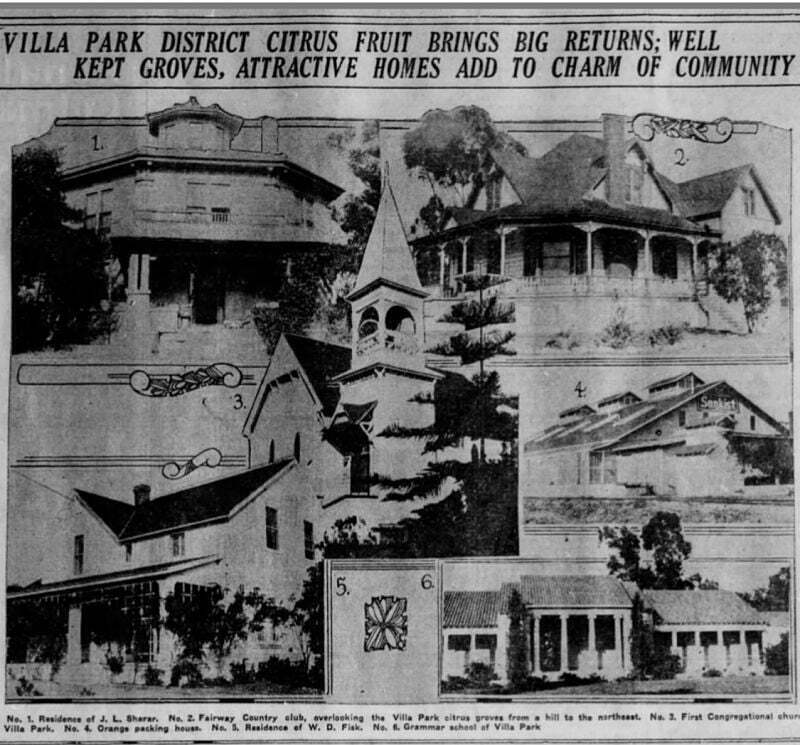
- Residence of J. L. Sharar
- Fairway Country Club, overlooking the Villa Park citrus groves from a hill to the northeast
- First Congregational Church of Villa Park
- Sunkist orange packing house
- Residence of W. D. Fisk
- Grammar school of Villa Park
More Villa Park History
- Facts About Villa Park
- Villa Park Fire History
- Villa Park Neighborhoods
- Villa Park Street Name Meanings
- Villa Park Town Center
- Villa Park Dam
Sources & Further Reading
For additional historical information, see the City of Villa Park history and historical materials maintained by Orange County agencies and local organizations.
Villa Park History FAQs
When was Villa Park, California founded?
Villa Park officially incorporated on January 11, 1962, becoming Orange County’s 24th incorporated city.
Why is Villa Park called Villa Park?
The community was originally known as Mountain View. When a local post office was established, another California community already used that name, so Villa Park was selected instead.
What was Villa Park called before incorporation?
The early community was known as Mountain View before the Villa Park name came into use in the late 1800s.
Why did Villa Park become a city?
Residents pursued incorporation largely to preserve local control, large residential lots and the community’s rural character as the neighboring City of Orange expanded.
What crops were historically grown in Villa Park?
Villa Park’s agricultural history included grapes, walnuts, apricots and citrus. Citrus eventually became the area’s dominant crop for roughly 60 years.
Why is Villa Park completely surrounded by Orange?
The city’s unusual boundaries developed during the incorporation and annexation process. Some properties were left outside Villa Park’s proposed boundaries, while surrounding areas were annexed by Orange.