
Fire has shaped Villa Park and the surrounding foothill communities for generations. This history includes fires that burned within Villa Park, threatened the community or significantly affected the broader Villa Park area, as well as the story of the local volunteer firefighters who once responded when the station siren sounded.
For events before Villa Park incorporated in 1962, references to “Villa Park” may describe the larger historic Villa Park district or surrounding community rather than the boundaries of today’s city. Historical acreage and damage estimates can also vary by source.
On this page: Fire Timeline | 1967 Paseo Grande Fire | How Fire Shaped Villa Park | Volunteer Fire Department | OCFA Today
Villa Park Fire History Timeline
Canyon Fire 2 — October 2017
Canyon Fire 2 burned in Anaheim Hills and Orange and prompted evacuations in nearby communities. Although Villa Park was not among the communities that suffered the fire’s major structural losses, the incident was a reminder of the wildfire exposure shared by communities near the eastern Orange County foothills.
Sierra Fire — February 2006
The Sierra Fire began near Sierra Peak in the Cleveland National Forest and produced a large smoke plume visible from Villa Park. Evacuations affected portions of nearby Anaheim Hills, Orange Park Acres and eastern Orange as firefighters worked to contain the fire near the 241 corridor.
Stagecoach Fire / Villa Park Fire — October 1993
The 1993 Stagecoach Fire, also referred to in reports as the Villa Park Fire, burned hundreds of acres and damaged or destroyed homes in the east Anaheim and Villa Park area. Contemporary accounts attributed the fire to a 17-year-old who deliberately set it near Queens Drive in Anaheim Hills.
Gypsum Canyon Fire — October 1982
The Gypsum Canyon Fire burned roughly 18,000 acres across the eastern Orange County foothills and destroyed homes in the broader Orange and Anaheim Hills area. Residents in and around Villa Park prepared for possible evacuation and watered roofs as the fire approached developed neighborhoods. Hall of Fame pitcher and Villa Park resident Bert Blyleven was also reported injured in a fall at his home during the fire.
Santiago Canyon Fire — December 1974
A wind-driven brush fire burned approximately 132 acres in the Santiago Canyon/Villa Park area. Contemporary reporting said about five homes on Santiago Boulevard were threatened and residents were evacuated, but no structures were damaged. Roughly 70 firefighters, 27 engine companies and two bulldozers were involved in the response.
Villa Park Mayor James Hyland credited rain from the previous week with helping prevent a potentially much more serious fire. Contemporary reports attributed the fire to juveniles playing with matches.
Villa Park Fire — September 1970
In September 1970, a series of fires burned in Orange County, including a Villa Park/Santiago Creek-area blaze reported at roughly 250 acres. Homes were threatened and residents used garden hoses on roofs while firefighters fought the flames. Investigators later suspected arson in the Villa Park and El Toro fires; arson should not be treated as a conclusively established cause.
Paseo Grande Fire — October 1967
The Paseo Grande Fire was one of the defining fire events of Villa Park’s early years as an incorporated city. Driven by Santa Ana winds during Halloween weekend, the fire forced evacuations as residents and ranchers confronted fast-moving flames. Contemporary accounts describe homeowners staying behind to hose roofs while others left for evacuation centers.
Approximately 173 acres were reported burned in the Villa Park area, with at least 12 homes lost. Across Orange County, the larger fire event burned tens of thousands of acres and destroyed dozens of homes. The fire also exposed problems associated with firefighting equipment and water pressure in rapidly developing foothill communities.
Among the historically significant losses associated with the fire was the former George Bixby property near the top of Loma. The fire’s aftermath became part of the broader discussion about vegetation, combustible roofing and fire protection as Villa Park and neighboring communities continued to develop. Newspaper coverage one year later documented rebuilding along Paseo Grande.
Foothill Fire — October 1958
A 1958 blaze was reported in the Santiago Creek bed near Windes Drive before spreading toward the foothills of the historic Villa Park area. Contemporary reports placed the burn area at roughly 500 acres. Because this fire predates Villa Park’s 1962 incorporation, references to Villa Park describe the broader community rather than necessarily today’s city boundaries.
Green River Fire — November 1948
The week-long Green River Fire swept through the Santa Ana Canyon region during strong Santa Ana winds. Historical reports describe more than 46,000 acres burned and 22 homes destroyed in Orange County. It is included here because of its impact on the canyon and foothill region surrounding the historic Villa Park community, not because the entire burn area was within today’s Villa Park.
Harding Canyon Fire — October 1926
The Harding Canyon Fire burned an estimated 13,000 to 15,000 acres in the region. It did not directly correspond to today’s Villa Park city boundaries, but it was part of a period in which large Southern California wildfires increased attention to organized firefighting, training and regional fire protection.
Villa Park Elementary School Fire — February 1926
The early Villa Park school buildings were destroyed in an overnight fire in 1926. Contemporary reports cited a faulty chimney flue or defective wiring as possible causes. Later historical accounts date Villa Park’s first school buildings to 1893 and the surviving older school buildings to 1926, making the fire an important dividing point in the history of Villa Park Elementary School.
Great Fire of 1889 / Santiago Canyon Fire
The Great Fire of 1889 was an enormous regional wildfire driven by dry conditions and Santa Ana winds. Historical acreage estimates vary, with some accounts placing the burn area at approximately 300,000 acres. The fire affected the region surrounding what was then the broader Villa Park agricultural district, decades before the City of Villa Park incorporated. The historical record does not justify treating the entire modern city as part of a precisely mapped 1889 burn area.
How Fire Shaped Villa Park
Villa Park’s fire history overlaps with its transformation from citrus groves and ranches into a large-lot residential city. Eucalyptus trees once lined roads and served as grove windbreaks, while horses and other livestock remained common even as new subdivisions appeared. During major fires, residents did more than protect houses: local recollections describe horses being moved to safer areas and tied along Wanda Street while flames threatened the community.
The Fitschen family history provides a particularly useful link between agriculture and firefighting. Harold “Pete” Fitschen, whose family operated a large citrus ranch in the area, served for 26 years with the Villa Park Volunteer Fire Department. Family recollections also describe residents moving horses during a major 1968 fire. Because that recollection gives a different year from the 1967 Paseo Grande Fire, it is treated here as a separate historical recollection rather than assumed to describe the same incident.
Villa Park Volunteer Fire Department
Villa Park’s volunteer firefighting tradition grew out of the area’s semi-rural character. The local volunteer department was established before incorporation, with residents including citrus growers, ranchers, pilots and retirees answering calls. Station 23 at Santiago Canyon Road served Villa Park and surrounding communities. During the 1969 floods, damage to the Santiago Boulevard crossing over Santiago Creek complicated local access and forced a lengthy detour for fire response until temporary access was established—an example of how Villa Park’s fire, creek and flood-control histories overlap. See Villa Park Dam and Historic Sites Along Santiago Creek. Volunteers responded when the station siren sounded and, later, when pagers alerted them.
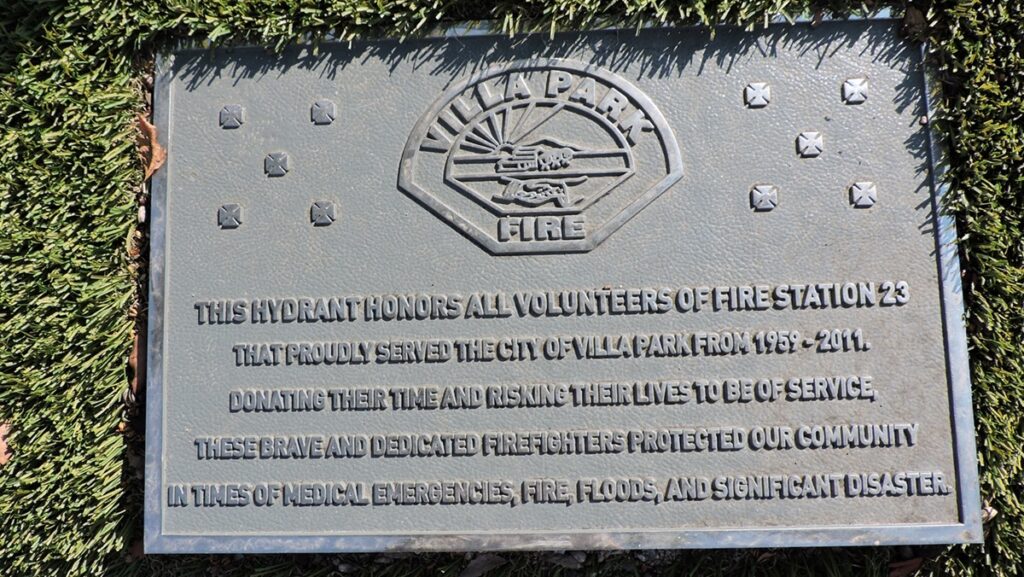
The California Division of Forestry (CDF) provided training for local volunteers, including firefighting, engine and pump operation, leadership and medical response. Historical accounts describe Wednesday evening training sessions and volunteers receiving $2 per call. The volunteers were local responders trained with CDF support; they should not be confused with CDF employees.
Full-time professional staffing gradually assumed a larger role, while volunteers continued serving the community for decades. The volunteer program ultimately ended in 2006 as the modern regional fire-service model replaced the earlier system.
Firehouse Pancake Breakfast
The Firehouse Pancake Breakfast grew out of Villa Park’s volunteer firefighting tradition. Historical accounts date the first breakfast to 1962, when it helped raise money for uniforms, training materials and other department needs. The event became part of Villa Park’s community traditions, although the historical record should not be read as proof that it has been held continuously every year since 1962.
Orange County Fire Authority in Villa Park Today
Today Villa Park receives fire and emergency services from the Orange County Fire Authority (OCFA). OCFA currently serves 23 Orange County cities and the county’s unincorporated areas, protecting nearly 2 million residents from 78 fire stations. Villa Park is part of OCFA Division 4.
Villa Park Fire Station 23
5020 Santiago Canyon Road
Orange, CA 92869
OCFA lists Station 23 as a career station serving Villa Park, with Medic Engine 23 and Patrol 23. The station traces its establishment to 1961. For emergencies, call 911. For current fire-prevention, evacuation and emergency information, use official OCFA and local emergency resources rather than historical information on this page.
Fire Safety and Emergency Resources
- Orange County Fire Authority
- Power Shutdowns During High Winds
- Tips for Protecting Your Family From Fires
- Villa Park Dam