
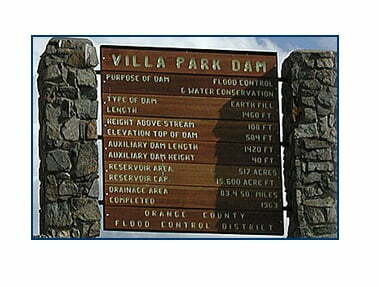
Villa Park Dam is an earthen embankment dam on Santiago Creek in the City of Orange, just outside Villa Park. Completed in 1963, it is a major Orange County flood-control facility that helps manage storm runoff and controlled releases moving downstream through Santiago Creek toward the Santa Ana River. The dam is downstream of Santiago Dam and Irvine Lake and helps protect downstream communities including Villa Park, Orange, Tustin and Santa Ana.
The reservoir behind Villa Park Dam is primarily for flood control rather than recreation. It is often low or dry during the dry season so storage capacity remains available for storm runoff. Controlled releases and storm flows can continue downstream through Santiago Creek and the regional flood-control system.
Overview | Location | Flood Control | History | 1969 Flood | Dam Safety | FAQ
Villa Park Dam Overview
Villa Park Dam is an embankment dam constructed primarily from compacted earth rather than a solid concrete structure. The County of Orange owns the dam, and OC Public Works implements the Orange County Flood Control District’s program for the design, construction, operation and maintenance of regional flood-control facilities.
Current California Division of Safety of Dams data lists Villa Park Dam as 118 feet high with a reservoir capacity of 15,600 acre-feet. An acre-foot is the volume of water needed to cover one acre of land one foot deep. The dam’s State Dam Number is 1012-0 and its National Inventory identification number is CA00829.
Where Is Villa Park Dam?
Despite its name, Villa Park Dam is located in the City of Orange near Villa Park and Santiago Oaks Regional Park. The commonly listed location near 8048 E. Lolita Street should be treated as a geographic reference rather than a public visitor entrance.
The dam is flood-control infrastructure, not a public recreational attraction, and this page should not be used as a guide for accessing the dam itself. For nearby public recreation, visit Santiago Oaks Regional Park or explore the Santiago Creek Trail.
Flood Control on Santiago Creek
Villa Park Dam is part of the larger Santiago Creek and Santa Ana River flood-control system. It stores storm runoff and allows water to be released downstream in a controlled manner when conditions permit. Discharge continues through Santiago Creek, where downstream facilities such as the Santiago Creek Recharge Basin can also play a role in water management and groundwater recharge.
Because flood-control storage is its primary purpose, the reservoir can appear nearly empty for long periods. That condition is not unusual for a flood-control reservoir.
Who Owns and Operates Villa Park Dam?
The County of Orange owns Villa Park Dam. The Orange County Flood Control District is responsible for regional flood-control works, and OC Public Works implements the District’s flood-control program, including operation and maintenance of regional and subregional facilities.
See OC Public Works for current agency information and public service resources.
Why Does Villa Park Dam Sometimes Smell?
Residents near Santiago Creek have occasionally noticed a sulfur-like or rotten-egg odor associated with some water releases from the reservoir. Historically, these odors have been attributed to water interacting with decomposing leaves and other organic material accumulated in the reservoir. Not every release produces an odor, and an odor by itself should not be interpreted as evidence of a dam-safety problem.
Villa Park Dam History
Planning for additional flood-control capacity along Santiago Creek dates back decades before Villa Park Dam was completed. In February 1958, contemporary newspaper coverage reported that the Orange County Board of Supervisors had ordered plans for a proposed earth-fill dam on Santiago Creek about four miles downstream from Santiago Dam. The preliminary project was estimated at about $3.38 million, with a proposed height of roughly 100 feet, a drainage area of about 84 square miles and storage of about 16,000 acre-feet. These were planning-era figures rather than the final specifications.
Villa Park Dam was ultimately completed in 1963. Current California dam records list the completed structure at 118 feet high with a capacity of 15,600 acre-feet. Comparing the 1958 proposal with the finished dam shows how the project developed from county flood-control planning into the facility that operates on Santiago Creek today.
Because the 1958 planning predates Villa Park’s 1962 incorporation, references to the Villa Park area from this period should not automatically be interpreted using today’s city boundaries. The dam itself is in the City of Orange, immediately outside modern Villa Park.
The 1969 Orange County Floods
Two long-duration, high-volume storms in January and February 1969 caused major flooding and erosion throughout Orange County. Orange County hydrology records state that the storms produced uncontrolled spillway flow at both Santiago Dam and Villa Park Dam. The spillways at both dams were damaged, two bridges failed and many other bridges were damaged.
The 1969 floods became an important event in the evolution of regional flood-control planning. Flooding also affected local access along Santiago Creek: the Santiago Boulevard crossing was washed out, complicating response from nearby Station 23 until temporary access could be established. This connects the dam’s history directly with Villa Park fire-service history and the broader history of Santiago Creek. Subsequent improvements were developed as part of a much larger system involving Orange County, the U.S. Army Corps of Engineers and other agencies. The Santa Ana River Mainstem project included improvements at major flood-control facilities and channels throughout the watershed rather than simply converting the entire river into a concrete channel.
The Villa Park Dam Keeper’s House
Villa Park Dam historically had an onsite residence for a dam keeper. Orange County records from 2020 identify the property above the dam as the former dam keeper’s home. The residence is approximately 1,585 square feet with an attached garage and sits on a roughly 2.4-acre Flood Control District property.
By 2020, Orange County no longer planned to station a dam keeper at the property and sought a tenant for the former residence. The county’s lease materials made clear that Villa Park Dam remained an active flood-control facility: any tenant would share certain access roads with the District, other dam areas would remain restricted, and proposed uses had to be compatible with ongoing flood-control operations.
The former residence provides a glimpse into an earlier period of dam operations when an onsite dam keeper was part of the facility. The records reviewed so far do not establish when the house was constructed, who the individual dam keepers were or exactly when onsite staffing ended. Those remain useful subjects for additional historical research.
The house and dam are operational-property areas rather than public attractions. See The Villa Park Dam Keeper’s House for additional history of the residence and the county’s 2020 leasing effort.
Villa Park Dam Safety & Classification
California’s Division of Safety of Dams (DSOD) currently lists Villa Park Dam with an Extremely High downstream hazard classification and a Satisfactory condition assessment. These terms measure different things.
Extremely High Hazard does not mean the dam is in extremely poor condition or that failure is expected. The hazard classification reflects the potential consequences to people and property downstream in the unlikely event of a dam failure. The condition assessment describes the evaluated physical condition and expected performance of the dam under applicable regulatory criteria.
DSOD regulates jurisdictional dams in California and reviews their design, construction, maintenance, repairs and safety. For current regulatory information, see the California Division of Safety of Dams.
Villa Park Dam Facts
| Year Completed | 1963 |
|---|---|
| Dam Type | Earthen embankment |
| Owner | County of Orange |
| Watercourse | Santiago Creek |
| Primary Purpose | Flood control |
| Dam Height | 118 feet |
| Reservoir Capacity | 15,600 acre-feet |
| DSOD Hazard Classification | Extremely High |
| DSOD Condition Assessment | Satisfactory |
| State Dam Number | 1012-0 |
| National ID | CA00829 |
Villa Park Dam FAQ
Is Villa Park Dam safe?
VillaPark.co does not make independent dam-safety determinations. California’s Division of Safety of Dams is the regulatory authority responsible for oversight of jurisdictional dams. Current DSOD data lists Villa Park Dam’s condition assessment as Satisfactory. Readers should use DSOD for current regulatory and safety information.
What happens if Villa Park Dam fails?
Potential effects are addressed through official dam-safety and emergency-planning processes. Rather than speculate about a failure scenario, residents should rely on California DSOD and local emergency-management agencies for current official information.