
Before Villa Park became the residential community it is today, much of the area was covered by ranches and citrus groves. Grapes, walnuts and apricots were grown here first, but oranges and other citrus eventually became the crop most closely associated with Villa Park. For roughly 60 years, citrus shaped the local economy, landscape and community.
The legacy of that era remains visible today. Villa Park’s large residential lots, several street names, its water system and even the city’s incorporation story are connected to the ranching families who worked the land.
How Citrus Shaped Villa Park
Villa Park developed as an agricultural district long before it incorporated as a city in 1962. Over time, citrus replaced earlier crops and became the area’s dominant agricultural industry. Orange and lemon groves surrounded ranch homes, while windbreaks helped protect orchards from Santa Ana winds.
Longtime rancher Harold Brewer recalled arriving in the area in 1923 when the landscape was overwhelmingly citrus, with groves, scattered homes and long driveways defining much of the community. His recollections provide a picture of Villa Park before suburban development transformed Orange County.
For a broader timeline of the community, see the history of Villa Park.
Villa Park’s Orange Groves and Ranches
Citrus ranching was a long-term investment. Young orange trees took years to mature, so growers sometimes planted vegetables or performed other agricultural work while waiting for their groves to become productive.
Once established, the orchards required year-round work including irrigation, cultivation, pruning and harvesting. During harvest, fruit was picked into field boxes and transported to packing houses where it could be prepared and shipped to markets outside Southern California.
The ranches also helped establish Villa Park’s low-density character. As groves were eventually subdivided for homes, larger parcels and estate-style development became part of the community’s identity.
The Ranching Families Behind Villa Park
The citrus industry was more than an agricultural business. Ranching families helped establish local organizations, water systems and civic institutions. Many of their names remain part of Villa Park’s geography.
Street names including Brewer, Nichols, Squire, Collins, Morrow, Regan, Knuth, Workman, Adams, Wulff, Abbott, Durfee and Sterling reflect families associated with the community’s earlier history. Hazel, Mary and Florence also survive as reminders of Villa Park’s past.
These families ultimately influenced more than street names. Citrus ranchers were among the residents who sought to preserve Villa Park’s large lots and local control as surrounding Orange County communities rapidly developed.
Villa Park Orchards Association
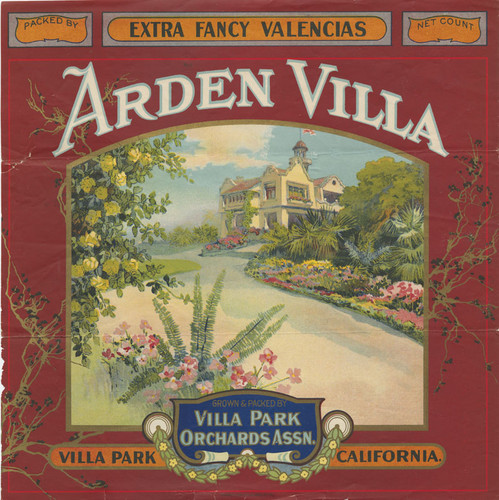
In the fall of 1912, 48 Villa Park growers organized the Villa Park Orchards Association (VPOA). The cooperative was created so growers could work together to harvest, pack and market their oranges.
Grower cooperatives allowed ranchers to share the costs of picking, hauling, packing and marketing fruit rather than relying entirely on independent packing and shipping companies. Villa Park Orchards became one of the institutions most closely associated with the community’s citrus era.
The organization outlived the local groves that gave it its name. Villa Park Orchards continues operating today as a grower-owned agricultural cooperative marketing citrus through Sunkist.
The Villa Park Packing House
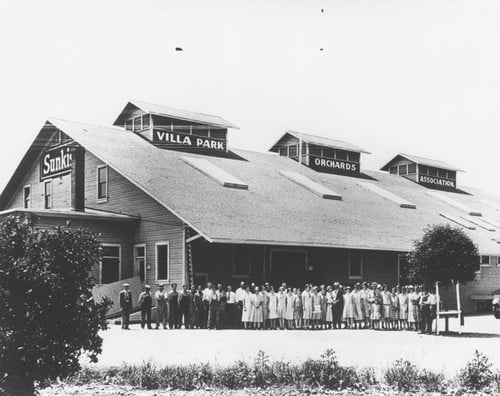
The Villa Park Orchards Association packing house became one of the community’s most recognizable agricultural landmarks. Located west of what is now the Villa Park Town Center area, it served growers whose fruit needed to be sorted, packed and shipped.
Inside a traditional citrus packing house, harvested fruit moved through several stages. Oranges could be stored temporarily, washed, dried, polished, graded by quality and sorted by size before being packed into boxes. Packed fruit was then prepared for shipment, including by rail to markets across the country.
As the citrus industry expanded beyond Villa Park, so did the association. By 1969, the City of Villa Park reports that Villa Park Orchards had 575 members representing approximately 6,000 acres and had become one of Sunkist’s major packing organizations.
The last packing at the Villa Park facility took place in 1978 as operations shifted to the Santiago Orange Growers packing house in Orange. The old Villa Park packing center was torn down in 1983.
Railroads and the Citrus Industry
The railroad was an important part of the agricultural economy. The Southern Pacific line serving the Villa Park district provided a way to move produce and other freight between local growers and larger markets.
Historic accounts describe freight, baggage and agricultural shipments moving through the area in the early 20th century. Citrus packed locally could ultimately travel by refrigerated rail car to customers far beyond California.
Parts of Villa Park’s former transportation and agricultural landscape later took on new uses as the community became residential.
Water Made the Groves Possible
Commercial citrus farming depended on reliable irrigation. Local growers organized water systems that helped transform dry ranch land into productive orchards. The Serrano Water Association and Villa Park Water Company were part of that agricultural infrastructure.
The connection between water and agriculture remains especially important to Villa Park history because the ranching community helped establish institutions that continued long after most of the groves disappeared.
From Orange Groves to Villa Park Neighborhoods
Residential development gradually replaced the orchards rather than eliminating them all at once. Some ranches continued operating while subdivisions and custom homes appeared around them.
Cerro Villa Heights illustrates that transition. The area was promoted as citrus ranch property during the early 20th century, with Valencia orange groves and larger agricultural parcels. Over time, those properties were divided and developed into residential neighborhoods.
That pattern occurred throughout the Villa Park area. Former ranch roads became residential streets, agricultural parcels became home sites and the large-lot landscape of the citrus era influenced the city’s later approach to residential development. Learn more about the community’s development in our guide to Villa Park neighborhoods.
The End of Commercial Citrus in Villa Park
After World War II, rapidly rising land values and residential growth changed agriculture throughout Orange County. Villa Park followed that larger trend as ranches were sold and subdivided for homes.
The transition took decades. Citrus remained visible even as the community incorporated and residential construction accelerated during the 1960s and 1970s. Villa Park’s last significant commercial orange grove ceased operation in 1989, marking the end of an agricultural era that had defined the area for generations.
Villa Park’s Citrus Legacy Today
Most of the commercial groves and the old packing house are gone, but citrus remains embedded in Villa Park’s identity.
- The city’s official flower is the orange blossom.
- Many streets carry the names of early ranching families.
- Large residential lots reflect the community’s agricultural origins and later efforts to preserve a low-density character.
- The Villa Park Orchards name continues through the agricultural cooperative founded by local growers in 1912.
- Local water institutions and infrastructure grew from the needs of the agricultural community.
Villa Park today looks very different from the landscape of orange and lemon groves that surrounded residents a century ago. Yet the citrus era helps explain why the city developed as it did—and why traces of its ranching history can still be found throughout the community.